The choice between solid wood and engineered wood in commercial furniture manufacturing involves trade-offs that are poorly understood outside the industry. Neither material is universally superior. The right choice depends on the specific application, environmental conditions, budget constraints, and sustainability priorities of each project. This comparison provides the technical foundation for making informed material specifications.
Defining the Materials
Solid Wood
Lumber cut directly from the tree and dried to a stable moisture content (typically 8-12% for furniture applications). Common species in commercial furniture include oak, walnut, ash, beech, birch, and various tropical hardwoods. Each species has distinct characteristics in terms of hardness, grain pattern, workability, and cost.
Engineered Wood Products
Composite materials manufactured from wood fibers, veneers, or particles bonded with adhesives:
- Plywood: Layers of wood veneer cross-laminated for dimensional stability. Furniture-grade plywood uses hardwood face veneers.
- MDF (Medium Density Fiberboard): Wood fibers bonded under heat and pressure. Extremely smooth surface ideal for painted finishes.
- Particle board: Wood particles bonded with resin. Lowest cost but also lowest structural performance.
- Blockboard: Solid wood core strips faced with veneer. Good balance of weight, strength, and cost for large panels.

Structural Performance Comparison
For furniture applications, the relevant performance metrics are:
- Screw holding strength: Solid wood excels, particularly in end-grain applications. MDF and particle board have poor screw retention, requiring specialized fasteners or threaded inserts for hardware-intensive applications like cabinets and wardrobes.
- Dimensional stability: Engineered wood wins decisively. Plywood and MDF resist seasonal expansion and contraction that causes solid wood panels to warp, cup, or crack. Critical for large flat surfaces like dining table tops and wardrobe doors.
- Impact resistance: Solid wood absorbs impacts better and can be repaired (sanded and refinished). MDF chips and cannot be effectively repaired once the surface is damaged.
- Weight bearing: Solid hardwood frames provide superior long-term structural integrity for load-bearing applications like bed frames and seating.
Application-Specific Recommendations
Based on our manufacturing experience across thousands of commercial projects:
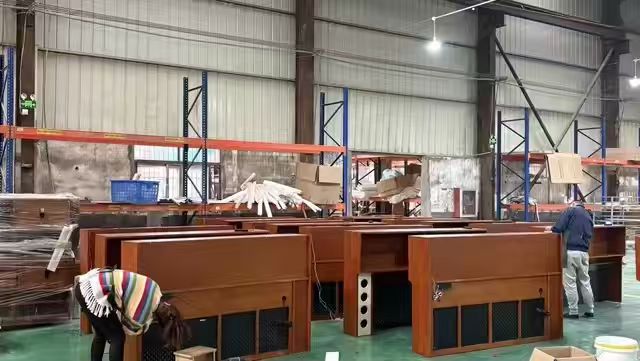
- Hotel room case goods (wardrobes, desks, minibars): Engineered wood (plywood or MDF) with hardwood veneer or laminate finish. Dimensional stability is critical in climate-controlled environments with seasonal humidity variation.
- Restaurant dining tables: Solid hardwood tops (minimum 25mm thickness) on metal or solid wood bases. The ability to sand and refinish extends service life significantly in high-wear food service environments.
- Office desking: MDF or plywood core with HPL (High Pressure Laminate) surface. Scratch resistance and easy cleaning outweigh aesthetic considerations in most office environments.
- Retail display furniture: Depends on brand positioning. Premium brands benefit from visible solid wood grain. Fast-fashion retail typically uses painted MDF for clean, modern aesthetics at lower cost.
- Bed frames: Solid hardwood for structural rails and legs; plywood for headboard panels and slat platforms. This hybrid approach optimizes both strength and cost.

Cost Comparison Framework
Material costs vary significantly by region and species, but relative pricing follows consistent patterns:
- Particle board: Baseline (1x)
- MDF: 1.3-1.5x baseline
- Furniture-grade plywood: 2-3x baseline
- Solid softwood (pine, poplar): 2-3x baseline
- Solid hardwood (oak, ash, beech): 4-6x baseline
- Premium hardwood (walnut, teak, cherry): 8-15x baseline
However, material cost is only one component. Labor costs for solid wood are higher due to more complex joinery, longer finishing processes, and higher waste rates (typically 30-40% waste for solid wood versus 10-15% for sheet goods).
Sustainability Considerations
Both material categories have legitimate sustainability arguments:
Solid wood advantages: Biodegradable at end of life, carbon sequestration during growth, repairable and refinishable (extending product life), no formaldehyde concerns with traditional joinery.
Engineered wood advantages: Higher yield from each log (less waste), can use fast-growing plantation species, utilizes wood that would otherwise be waste (chips, fibers), enables use of certified sustainable veneers over less expensive cores.
For projects with specific sustainability certification requirements (FSC, PEFC, LEED credits), we source certified materials and provide chain-of-custody documentation. Our manufacturing facility maintains FSC chain-of-custody certification for projects requiring it.
Making the Right Specification
The optimal approach for most commercial furniture projects is a hybrid specification that uses each material where its properties are most advantageous. Our engineering team regularly helps clients develop specifications that balance performance, aesthetics, cost, and sustainability goals. Contact us with your project requirements for material recommendations tailored to your specific application, budget, and market.